Home › Destinations › Dawlish
Dawlish
Dawlish is a small Regency seaside town on the south Devon coast between Exeter and Teignmouth, best known for the railway that runs right along its sea wall. Trains pass a few metres from the beach, between the red sandstone cliffs and the waves, and the station platform is practically on the sand. In the middle of town, the stream called Dawlish Water runs through a long ornamental garden known as the Lawn, home to the town's famous black swans. Two miles north, Dawlish Warren is a sand spit at the mouth of the Exe with dunes, a nature reserve and holiday parks.
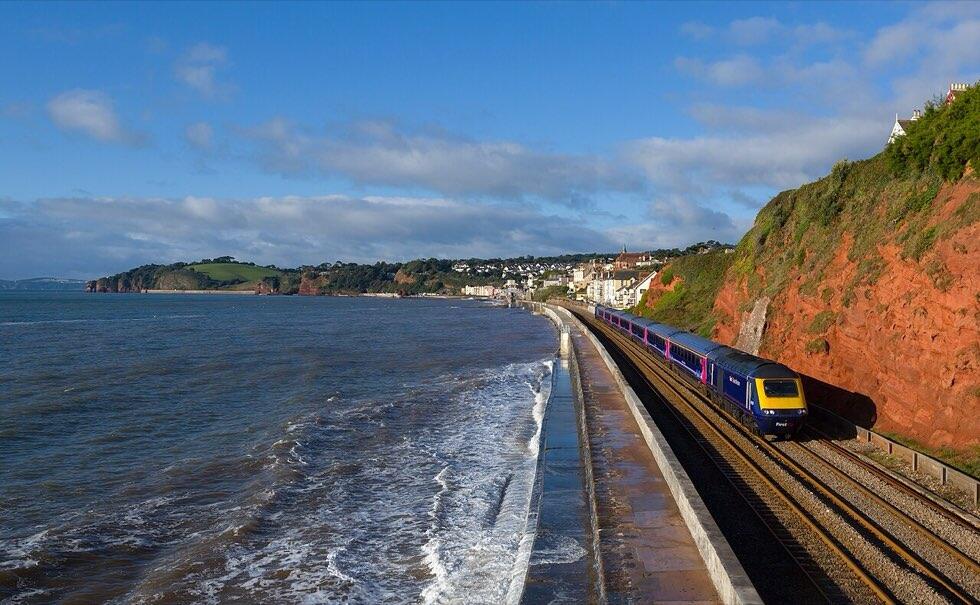

It suits a quiet, traditional seaside stay, a car-free holiday, and anyone who likes trains or coastal walks. It is smaller and less busy than Torquay. Dawlish Warren, by contrast, is the place for a big sandy beach, holiday parks and amusements.
Getting there
Dawlish station is on the main line between Exeter and Newton Abbot, about fifteen minutes from Exeter St Davids by local train. Some long-distance trains from London Paddington and the north stop here; otherwise change at Exeter. Dawlish Warren has its own station, next to the beach. By car, the A379 runs along the coast from Exeter and on to Teignmouth. Parking in the centre is limited; there are car parks by the Lawn and near the beach.
The sea wall and the railway
The line along the coast was built by Isambard Kingdom Brunel in the 1840s, originally for an experimental "atmospheric" railway in which trains were pushed by air pressure along a pipe. The system was abandoned within a year, but the pumping house survives at Starcross up the line. The railway itself remains, on a sea wall through five short tunnels in the cliffs between Dawlish and Teignmouth.
In February 2014 a storm destroyed a section of the wall at Dawlish, leaving the track hanging in mid-air and cutting off rail links to most of Devon and Cornwall for two months. A new, higher sea wall with a wider promenade was completed in the years since, and it has improved the walk along the front.
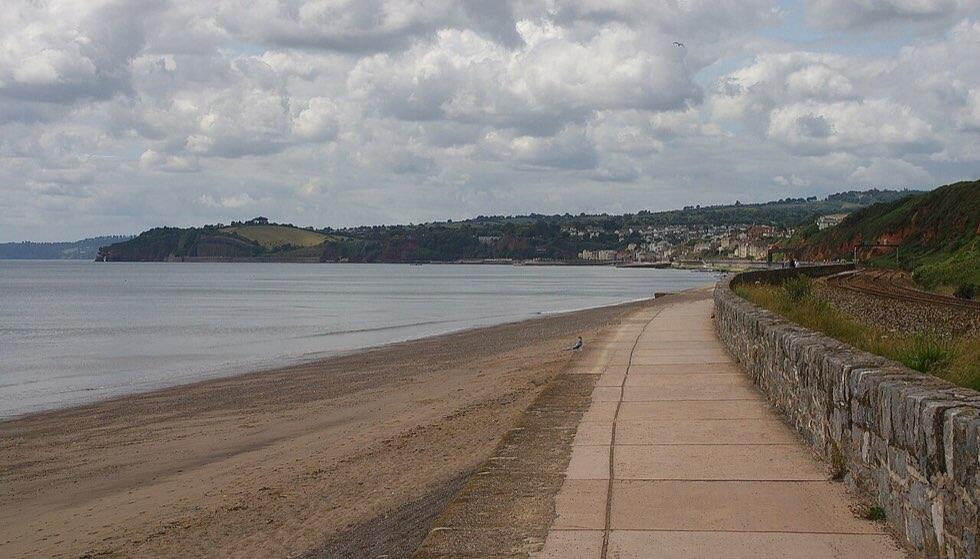
The sea wall walk is one of the pleasures of a stay here. Northwards, it runs past Langstone Rock to Dawlish Warren; southwards, past Coryton Cove and the Parson and Clerk rocks towards Holcombe and Teignmouth. You walk beside the trains and the sea, and you can catch a train back. In rough weather or high tides, waves break over the wall and sections close.

The Lawn and the black swans
The Lawn is a long park running from the seafront up the valley of Dawlish Water, with lawns, flower beds, bridges and small waterfalls where the brook drops over weirs. Black swans, originally from Australia, have lived here for more than a century and are now the town's emblem. Other waterfowl crowd the brook too. It is a lovely, slow place for an afternoon, and the shops and cafés of the town centre line the streets either side.
Beaches
- Town beach: sand and shingle in front of the station and the sea wall. At high tide it can disappear entirely.
- Coryton Cove: a small, sheltered cove reached along the sea wall to the south, popular with families. Once reserved for gentlemen bathers.
- Dawlish Warren: a long sandy beach with lifeguards in summer, backed by dunes, amusements and cafés.
Dawlish Warren nature reserve
The Warren is a mile and a half long spit of sand and dunes reaching across the mouth of the Exe towards Exmouth. Most of it is a national nature reserve, with a visitor centre and a bird hide looking over the estuary. It is a major site for wading birds in winter, when thousands of dunlin, oystercatchers and other waders feed on the mud flats. The dunes also support rare plants, including the tiny Warren crocus that flowers in spring. Seasonal ferries cross from Starcross, up the estuary, to Exmouth.
Where to stay
In Dawlish itself, there are small hotels and guest houses along the seafront and near the Lawn, holiday flats in Regency and Victorian terraces, and a few larger hotels on the hills. Holcombe, just south, has quieter self-catering houses above the cliffs. Dawlish Warren is dominated by large holiday parks with caravans, chalets and lodges, entertainment and pools. It is a good choice for families on a budget, and noisy for anyone who wants peace. Check what is included, as on-site facilities vary.
When to go
Summer is busy, especially at the Warren. The town hosts a carnival in August. Spring and autumn suit walking and birdwatching, and the town is calm. In winter, storms make the sea wall dramatic to watch from a safe distance, and the Warren is at its best for birds.
A day plan
Walk the Lawn in the morning, then follow the sea wall south to Coryton Cove for a swim or a coffee. In the afternoon, take the train or walk north to Dawlish Warren and spend an hour in the nature reserve's hide before returning along the beach. Train enthusiasts will want to stand at the end of the platform or on the wall near Langstone Rock to photograph express trains passing the cliffs.
Practical notes
- The station platform is very close to the sea, and trains pass at speed. Stay behind the yellow line.
- Paths along the sea wall close in storms. Check notices before you set out.
- Nearby guides: Teignmouth, Shaldon, Exeter and Torquay.
Frequently asked questions
Can you watch the trains on the sea wall?
Yes, and many people come to Dawlish to do exactly that. The sea wall promenade between the station and Langstone Rock, and the path towards Coryton Cove, give close views of trains running beside the sea. Stay behind barriers and away from the edge of the platform. In stormy weather the spray is spectacular, but the walkway can close and it is safer to watch from higher ground.
Is Dawlish Warren the same as Dawlish?
No. Dawlish is the small Regency town with the Lawn and the station by the sea wall. Dawlish Warren is a separate area about two miles north, with a long sandy beach, holiday parks, amusements and the nature reserve on the sand spit. Both have their own stations on the same line, a few minutes apart, and the sea wall path links them on foot.
Where can I see the black swans?
On the Lawn, the park in the centre of town that follows Dawlish Water from the seafront inland. The swans live there all year with other waterfowl, and nest along the brook. Please do not feed them bread; signs explain what is suitable. The Lawn is a short walk from the station and the beach.
Is Dawlish a good base for Exeter and Dartmoor?
For Exeter, yes: trains take about fifteen minutes. For Dartmoor, a car is needed, and the drive to Haytor or Bovey Tracey takes around half an hour. Dawlish also works well for the rest of the Riviera coast, with Teignmouth and Torquay easy to reach by train.
Guide me to UK is an independent information site. We do not own hotels or take bookings. Fares, opening hours and timetables change, so confirm them before you travel. Last updated 1 November 2026.