Home › Destinations › Teignmouth
Teignmouth
Teignmouth is a working port and a Georgian seaside town at the mouth of the River Teign in south Devon. It has two faces. The seafront, with its long sandy beach, pier, promenade and the green called the Den, faces the open sea. Round the corner, the Back Beach looks across the estuary to Shaldon, with fishing boats pulled up on the sand, the passenger ferry, and the red headland of the Ness on the far side. The town between them is a compact grid of shops, pubs and terraces.
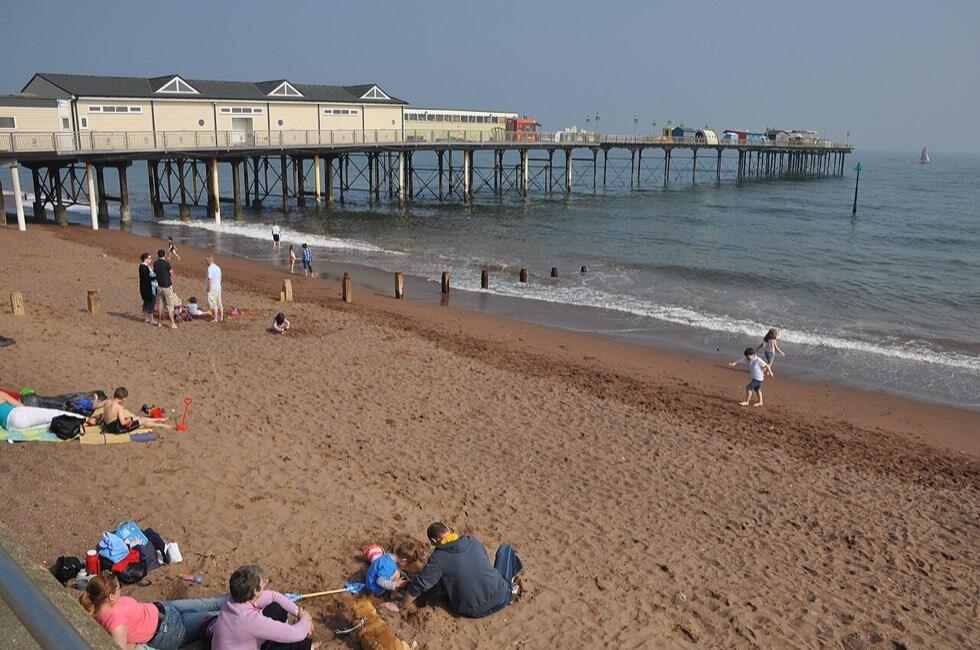

It is smaller and calmer than Torquay, and less dominated by holidaymakers. It suits people who want a sandy beach, a pier, a station and good walking in both directions, without needing a car. Families, couples and walkers all use it, and it is a good base for the Riviera coast and the eastern edge of Dartmoor.
Getting there
Teignmouth station is on the main line between Exeter and Newton Abbot, a few minutes' walk from the seafront. Some trains from London Paddington stop here directly; others call at Exeter St Davids or Newton Abbot, where you change to a local train on the Riviera Line. The approach from Exeter runs along the famous sea wall through Dawlish, with the railway right beside the water.
By car, the A381 from Newton Abbot and the A379 coast road from Exeter both reach the town. The A379 continues over the Shaldon Bridge towards Torquay. Long-stay car parks are near the station and on the Point. The town centre is small and best explored on foot.
The seafront and the Den
The beach runs for about a mile from the Point, at the mouth of the estuary, to the cliffs at Holcombe. At high tide it narrows; at low tide it is wide and sandy. The Grand Pier, opened in the 1860s, has amusements and rides. Behind the promenade, the Den is a broad lawn with gardens, a bowling green, and the Pavilion with its café and events space, laid out in the early nineteenth century on what had been sand dunes. On the Point, a small lighthouse marks the harbour entrance and there are views over the shifting sandbars at the river mouth.
The Teignmouth and Shaldon Museum, known locally as TQ14, tells the story of the port, its shipbuilding and smuggling, and the wreck of an Italian ship from the Spanish Armada era found offshore.
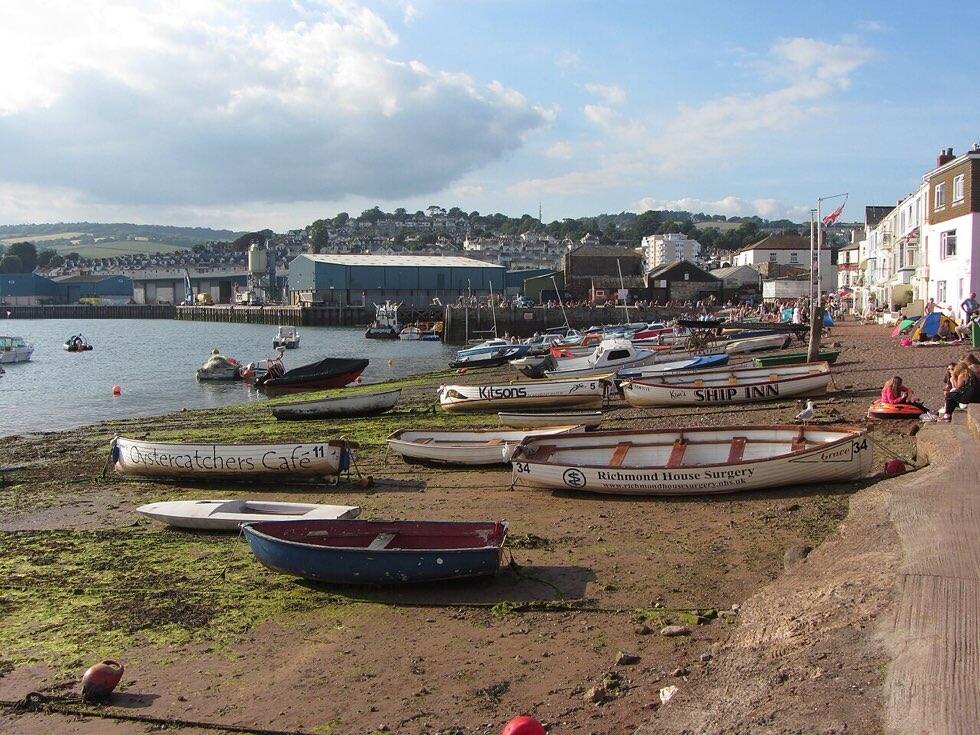

The Back Beach and the estuary
The Back Beach is the town's most characterful corner: fishing boats, boatyards, crab lines and the view across the water. From here the Shaldon ferry, one of the oldest passenger ferry services in England, crosses to Shaldon in a few minutes. The boats are painted in a black-and-white pattern often said to recall Tudor-era ships. The ferry runs most of the year in daylight, more often in summer, and stops in rough weather or very low tides.
Upriver, the port still ships ball clay from the Bovey basin, so you may see cargo ships coming in on the tide. The estuary is good for birdwatching, especially in winter.
Walks
- The sea wall to Dawlish (about 3 miles): from the east end of the seafront, the walkway beside the railway leads past the Parson and Clerk rocks to Holcombe and on to Dawlish. Part of the route is on the railway sea wall and part inland; it is closed in rough seas. Return by train.
- Over the ferry to Shaldon and the Ness: cross on the ferry, climb through the smugglers' tunnel to Ness Cove or walk up the Ness headland for views back over the town.
- The coast path south (about 6 miles from Shaldon to Babbacombe): a demanding but beautiful stretch of red cliffs and wooded valleys, with buses back to Teignmouth.
- The Templer Way: a long-distance route following the old granite tramway and canal from Haytor on Dartmoor down to Teignmouth, telling the story of how granite and clay reached the sea.
Where to stay
The seafront terraces have small hotels, guest houses and holiday flats with sea views. Rooms in the streets behind the Den are quieter and often cheaper. Around the Back Beach and on the hill at Bitton and Haldon Avenue you will find cottages and apartments, some with estuary views. Holcombe, just north, has a handful of rental houses above the cliffs. There are holiday parks inland and at Dawlish Warren a short drive away.
Because Teignmouth is on the railway, it is easy to stay car-free. If you are driving, ask about parking: many seafront properties have none.
When to go
Summer brings the busiest beach days, crabbing on the Back Beach and evening events on the Den. The town also has music and folk festivals at various times of year, and Shaldon's regatta and water carnival in summer are a short ferry ride away. Spring and autumn are good for walking and quieter beaches. Winter is very quiet, but the seafront walks and the estuary still work, and some cafés stay open.
A weekend plan
Saturday: arrive by train, walk the seafront and the pier, then go round to the Back Beach for the ferry to Shaldon. Walk up the Ness, have lunch in the village, and come back across the water. Sunday: walk the sea wall to Dawlish in the morning, have a look at the Lawn and its black swans, and take the train back. If the weather turns, the museum and the cafés on the seafront are the fallback.
Practical notes
- The sandbars at the river mouth move, and currents there are strong. Do not swim near the Point.
- The sea wall walk is closed in storms. Waves can break over it even on a dry day with a strong easterly wind.
- Teignmouth is a good place to base a Riviera trip: Dawlish is four minutes away by train, Exeter about twenty, and Torquay about half an hour.
Frequently asked questions
How often does the Shaldon ferry run?
The ferry runs frequently in daylight, with more crossings in summer than in winter. It stops in rough weather, and at very low tides the landing points change. There is no fixed timetable in the usual sense: the boat shuttles back and forth as demand allows. Check the ferry's own information or ask at the Back Beach for the last crossing time if you plan to cross back in the evening.
Is Teignmouth a good base without a car?
Very good. The station is a few minutes' walk from the seafront and has direct trains along the coast to Dawlish and Exeter, and to Newton Abbot and Torquay. The ferry takes you to Shaldon and the coast path south. Buses run along the coast road. A car is useful only for trips onto Dartmoor or into the South Hams.
Can you walk from Teignmouth to Dawlish?
Yes. The route along the sea wall and the cliffs is about three miles, with views of the Parson and Clerk rocks, the railway and the sea. Part of the route follows the sea wall beside the tracks and part goes inland around Holcombe. It closes in rough weather, when waves break over the wall. Return by train in a few minutes.
What is the Templer Way?
It is an eighteen-mile walking route from Haytor on Dartmoor down to Teignmouth. It follows the route by which granite from the Haytor quarries travelled to the sea in the nineteenth century: by a granite-railed tramway, then by the Stover Canal and the Teign estuary. The route passes woods, canal remains and estuary villages. It is waymarked and can be walked in sections.
Guide me to UK is an independent information site. We do not own hotels or take bookings. Fares, opening hours and timetables change, so confirm them before you travel. Last updated 1 November 2026.