Home › Destinations › Bath
Bath
Bath is a honey-coloured city in a bowl of hills in Somerset, built almost entirely from the local limestone that gives it its colour and its unity of style. It is famous for two things from very different eras: the Roman baths built around Britain's only natural hot springs, and the sweeping Georgian terraces and crescents put up in the eighteenth century when Bath became the most fashionable spa town in the country. The whole city centre is a UNESCO World Heritage Site, which is unusual for an entire working city rather than a single monument.

It suits a city break of one to three days, couples, architecture and history enthusiasts, and anyone travelling from London who wants somewhere with a genuinely different character within reach for a day or a weekend. Bath is small enough to see on foot, but hilly in places.
Getting there
Bath Spa station sits in the middle of the city, on the main line between London Paddington and Bristol, with fast trains from London taking around ninety minutes. There are also direct services from Bristol, Cardiff, Southampton and Salisbury. By car, Bath is just off the M4, reached via the A46 or A4, but the historic centre has narrow streets, restricted traffic zones and limited, expensive parking, so most visitors use one of the park and ride sites on the edge of the city and finish the journey by bus. Bristol Airport is about forty-five minutes away by road, with a direct bus link.
The Roman Baths and the hot springs
Bath sits on the only hot springs in Britain, where water heated deep underground rises at a steady 46°C. The Romans built a temple and bathing complex around the springs shortly after they arrived in Britain, and much of that structure survives below today's street level. The Roman Baths museum, entered from the Pump Room, lets you walk around the Great Bath itself, the original Roman paving, and the remains of the temple to Sulis Minerva, the Celtic and Roman goddess the site was dedicated to. An audio guide, included in the ticket, explains the engineering in detail. Booking a timed entry online ahead of a visit is strongly advised in summer.
You cannot bathe in the Roman Baths themselves, but the Thermae Bath Spa, a modern building a short walk away, draws on the same springs and has a rooftop open-air pool with views across the city rooftops, open to day visitors who book a session.
Georgian Bath
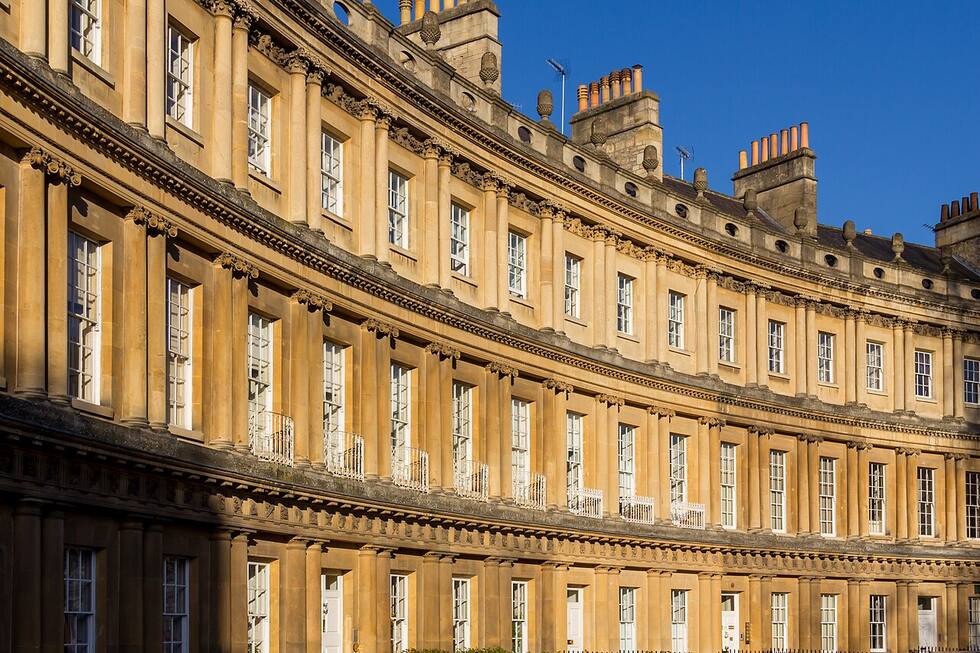
- The Royal Crescent. A curved terrace of thirty houses built in the 1770s, widely considered one of the finest examples of Georgian architecture in Britain. Number 1 Royal Crescent is open as a museum furnished as it would have been in the eighteenth century.
- The Circus. A circular arrangement of houses nearby, designed by the same father-and-son architects, John Wood the elder and younger, who shaped much of Georgian Bath.
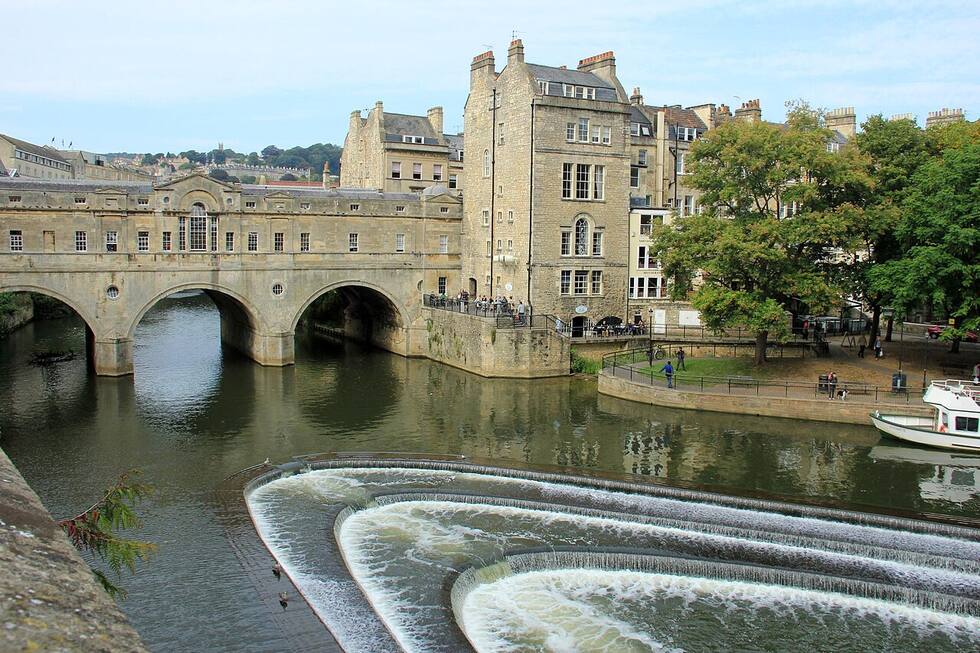
- Pulteney Bridge. One of only a few bridges in the world lined with shops on both sides, crossing the River Avon beside a dramatic horseshoe-shaped weir. The view from the bridge, or from Parade Gardens below, is one of the most photographed in the city.
- Great Pulteney Street. A long, wide Georgian avenue leading from Pulteney Bridge, built as part of a planned new town across the river that was never fully completed.
- Bath Abbey. A late-medieval church on the site of earlier Saxon and Norman buildings, known for its fan-vaulted ceiling and the "ladders to heaven" carved into its west front.

Museums and other sights
- The Jane Austen Centre. Bath features in two of Austen's novels and she lived in the city for several years; the centre on Gay Street explores that connection, with costumed guides.
- The Fashion Museum. A collection of historic and contemporary dress, housed for many years in the Assembly Rooms and now moving to a new building on Bennett Street; check its current location before visiting.
- The American Museum and Gardens. At Claverton Manor on the edge of the city, with period American interiors and extensive grounds, best reached by car or bus.
- Prior Park Landscape Garden. An eighteenth-century garden on a hillside above the city, run by the National Trust, with a Palladian bridge and views back over Bath. It can be reached on foot via the Bath Skyline walk.
Walking and the river
The Bath Skyline is a six-mile circular walk along the wooded hills around the city, with views down over the rooftops and the abbey, maintained by the National Trust. Closer to the centre, a level path follows the River Avon and the Kennet and Avon Canal, with boat trips available from near Pulteney Bridge in season. The canal towpath east of the city, past the Dundas and Avoncliff aqueducts, is a pleasant longer walk or cycle ride towards Bradford on Avon.
Where to stay
The streets around the centre, including those near Great Pulteney Street and the area north towards the Circus and Royal Crescent, have boutique hotels and guest houses in Georgian townhouses, often with steep internal stairs and no lift. The station end of town, around Manvers Street and Widcombe, has more modern hotels and is convenient for arriving by train. For something quieter, the villages and small towns in the surrounding countryside, such as Bathampton and Batheaston, have inns and B&Bs a short bus ride from the centre.
When to go
Spring and autumn are comfortable for walking and sightseeing without the summer crowds. Christmas brings a well-known market around the abbey, and the city is busy then. Summer is the warmest but also the most crowded, especially around the Roman Baths and Pulteney Bridge. The Bath Festival in spring brings music and literature events across the city.
A two-day plan
Day one: the Roman Baths and Pump Room in the morning, Bath Abbey next door, then an afternoon walk via Pulteney Bridge and Great Pulteney Street, finishing at the Royal Crescent and the Circus for sunset. Day two: the Jane Austen Centre or Number 1 Royal Crescent, a walk or part of the Bath Skyline for the views, and an afternoon at Thermae Bath Spa if you want to finish with a soak.
Frequently asked questions
Can I visit Bath on a day trip from London?
Yes, though it is a long day. Trains from London Paddington take around ninety minutes, so a day trip gives you roughly five or six hours in the city. For the Roman Baths, the abbey and a walk round the Georgian streets, that is enough; a proper look at the museums and a river trip needs an overnight stay.
Do I need to book the Roman Baths in advance?
Booking a timed slot online is strongly recommended, especially in summer and at weekends, because the site limits numbers inside the ancient chambers. Walk-up tickets are sometimes available but queues can be long, and prices are usually lower online.
Is Bath easy to get around on foot?
Mostly yes, since the main sights are within the old city centre, but the streets are hilly and some, including parts of the Royal Crescent area, climb steeply. Comfortable shoes help. A park and ride system on the edge of town is the easiest way in if you are driving.
Can you still swim in Bath's hot springs?
Not in the Roman Baths themselves, which are a historic monument rather than a working pool. The Thermae Bath Spa, a separate modern building nearby, uses the same natural hot springs and has a rooftop pool open to visitors who book a session.
Guide me to UK is an independent information site. We do not own hotels or take bookings. Fares, opening hours and timetables change, so confirm them before you travel. Last updated 19 November 2026.